
Range (music)
The distance between lowest and highest pitch an instrument or voice can play.

Michal Klajban · CC BY-SA 4.0
Range (music) refers to the distance between the lowest and highest pitch a musical instrument or voice can produce. It is also known as chromatic range, and in British English, the term 'compass' is used synonymously. The concept is fundamental to understanding the capabilities and limitations of instruments and voices in musical composition and performance.
- field
- Music theory
- known_for
- Defining the span of pitches an instrument or voice can produce
- related_terms
- Sounding range, written range, designated range, duration range, dynamic range
Lore & Background
The range of a musical instrument is the distance from its lowest to highest pitch. For singing voices, the equivalent is vocal range. The range of a musical part is the distance between its lowest and highest note. Among British English speakers, 'compass' means the same as chromatic range.
Reader's Guide
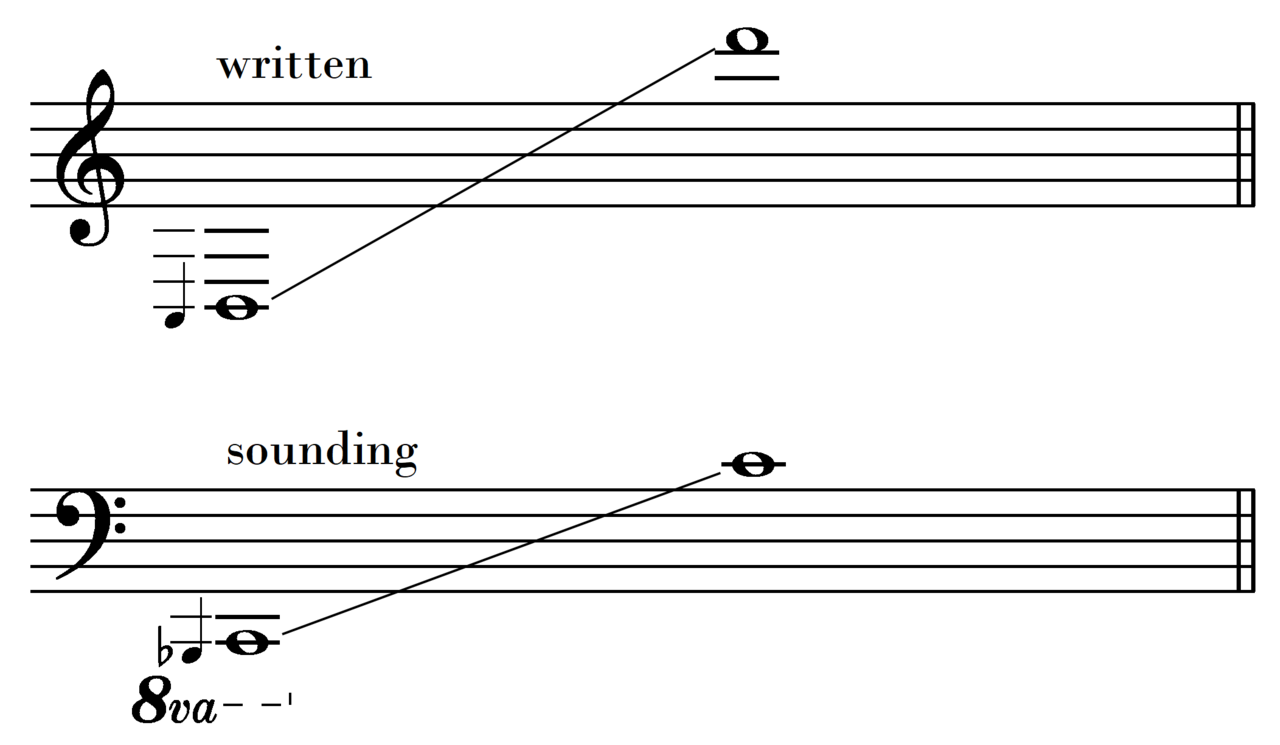
The concept of range is essential for composers and performers. The sounding range refers to the pitches actually produced, while the written range is the span of notes in sheet music, which may be transposed (e.g., a piccolo sounds one octave higher than written). The designated range is the set of notes a player should comfortably achieve. Duration range is the difference between shortest and longest rhythm; dynamic range is the difference between quietest and loudest volume. Woodwind and string instruments have no theoretical upper limit but cannot go below their designated range; brass instruments can play below their designated range, producing pedal tones. Classical arrangements rarely push instruments beyond their designed range, though 20th-century works sometimes call for pedal tones in bass trombones. The pipe organ can sound as low as C−1 (8 Hz), below human hearing, and with acoustic combination, C−2 (4 Hz).
Did You Know?
- The lowest note a pipe organ can sound with a true pipe is C−1 (8 Hz), below the range of human hearing.
- Brass instruments can play notes lower than their designated range, called pedal tones.
- A piccolo typically has a sounding range one octave higher than its written range.
- Many speakers have a low limit of around 40–60 Hz in terms of recording and reproduction.
Defining the Discipline
Music theory occupies a unique space in the study of sound, and the Oxford Companion to Music identifies three distinct but interconnected meanings behind the term. At its most basic level, it refers to the foundational literacy needed to read and interpret musical notation—understanding key signatures, time signatures, and rhythmic markings. At a second level, it encompasses the long scholarly conversation about music stretching from the ancient world to today. At a third level, it functions as a branch of musicology dedicated to identifying the underlying processes and universal principles that govern musical practice. What sets the musicological approach apart from straightforward musical analysis is its starting point: rather than examining a single piece or performance, it looks at the raw materials—pitches, rhythms, structures—from which all music is constructed. This distinction means that music theory is less about judging one work than about understanding the architecture that makes any work possible.
Ancient Foundations
The roots of music theory reach remarkably far back in human history. In Mesopotamia, Sumerian and Akkadian clay tablets preserve lists of intervals and tuning systems, with the earliest examples predating 1500 BCE—roughly a thousand years before comparable musical thought appears in any other known culture. Remarkably, all surviving Mesopotamian musical texts share a consistent terminology that remained in use for over a millennium, suggesting a stable and deeply embedded theoretical tradition. In China, the story takes a different path. Chinese musical thinking is organized around fundamental numbers: twelve pitches for scale construction, five notes for the pentatonic system, and eight categories of instruments classified by material. The Lüshi chunqiu, dating to around 238 BCE, recounts the legend of Ling Lun, who, at the Yellow Emperor's command, crafted twelve bamboo pipes by matching the tones of singing phoenixes. Beyond pure acoustics, ancient Chinese theory also grappled with music's moral and social role, as seen in the Yueji, which wove Confucian ethics into discussions of musical practice.
Practical and Scholarly Traditions
Music theory is not confined to academic institutions. As a practical discipline, it lives in the hands of composers, performers, and instrument makers across every culture. The transmission of theoretical knowledge can occur through oral traditions, physical instruments, and written treatises, and these channels frequently overlap. Prehistoric instruments unearthed at archaeological sites around the world offer tangible evidence of the sonic possibilities their makers understood, hinting at theoretical frameworks that never made it onto the page. In many ancient and living cultures, the deep roots of music-making are visible in the very tools and songs passed down through generations. When cultures do formalize their knowledge—through written treatises or notation systems—those practical documents often cite earlier works in the same way scholarly papers reference prior research. This blending of craft and scholarship means that a luthier adjusting a string tension and a university professor writing a paper on tuning systems are, in a sense, engaged in the same ongoing conversation about how sound is organized and understood.
Modern Framework and Universal Scope
In contemporary academia, music theory sits as a subfield within musicology, the broader study of musical cultures and their histories. The philosopher Guido Adler, writing in one of the foundational texts of musicology in the late nineteenth century, made a sweeping claim: the science of music was born simultaneously with the art of sound itself. For Adler, music could only truly exist once people began measuring pitches and comparing them to one another, and he concluded that every culture capable of producing an art of sound necessarily also possesses a science of sound. This universalist perspective implies that music theory is not a Western invention but a human constant. In practice, modern music theorists employ a wide toolkit—mathematics, graphic analysis, statistical methods, and the detailed reading of Western notation—while textbooks, particularly in the United States, often blend acoustics, notation, harmony, and counterpoint into a single curriculum. Teaching at the tenure-track level in American and Canadian universities typically demands a master's or doctoral degree, underscoring the discipline's depth and rigor.
Gallery





Frequently Asked Questions
What does 'range' mean in music theory?
In music theory, range is the total span of pitches—from the lowest to the highest note—that a given instrument or voice type can actually produce. It is a foundational concept for understanding both the capabilities and the limits of any performing medium.
What's the difference between 'range' and 'compass' in music?
They are synonyms; 'compass' is simply the British English term while 'range' is the American English equivalent. Both describe the distance between the lowest and highest playable pitches on an instrument or voice.
What's the difference between written range and sounding range?
Written range refers to the pitches as notated on the staff, whereas sounding range reflects the actual pitch the listener hears. For transposing instruments such as the B♭ trumpet or A clarinet, these two spans differ because the instrument sounds at a different pitch than what is written.
Why does an instrument's range matter to a composer?
A composer must know the exact range to write parts that are physically playable and to exploit the full tonal color of the instrument. Ignoring those limits can produce notes that are impossible to sound or that come out weak and uncontrolled.
What is chromatic range in music?
Chromatic range is an alternate name for the full pitch span (including all accidentals) between an instrument's or voice's lowest and highest notes. It distinguishes the complete available span from a diatonic-only span that would exclude sharps and flats.
More in Music Theory And Composition 25-27
Elsewhere in the Music Theory And Composition universe
Spotted an error? Know more?
This is a living reference — every entry is fact-audited, and reader corrections feed straight into our audit queue. Suggest an edit · See this site's audit record