
Chromatic scale
A twelve-pitch scale with semitone intervals, used in Western music.

Hyacinth · Public domain
The chromatic scale is a musical scale consisting of twelve pitches within an octave, where the interval between any two adjacent notes is a semitone. It is a common layout of pitches for fixed-pitch instruments such as the piano and guitar, which are called chromatic instruments.
- definition
- A set of twelve pitches within an octave, each a semitone apart
- common tuning
- 12-tone equal temperament
- interval ratio
- The twelfth root of two, approximately 1.06
- etymology
- From Greek 'chroma', meaning color
Lore & Background
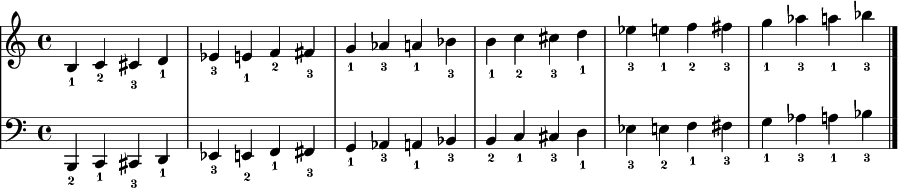
The chromatic scale has no set enharmonic spelling that is always used; its spelling is often dependent upon major or minor key signatures and whether the scale is ascending or descending. In general, it is notated with sharp signs when ascending and flat signs when descending, and so that no scale degree is used more than twice in succession. The word chromatic comes from the Greek 'chroma', meaning color, and the traditional function of the chromatic scale is to color or embellish the tones of the major and minor scales.
Reader's Guide
The chromatic scale is significant because it comprises all the pitches of the 12-tone equal-tempered system, the most common tuning in Western music. It does not define a key but gives a sense of motion and tension, and has long been used to evoke grief, loss, or sorrow. In the twentieth century it became independent of major and minor scales and is used as the basis for entire compositions. Chromaticism refers to the introduction of some pitches of the chromatic scale into music that is basically diatonic in orientation, or music based on the chromatic scale instead of the diatonic scales. The chromatic scale may be tuned in several ways, including Pythagorean tuning and 5-limit just intonation, which produce slightly different interval sizes. In non-Western cultures, the ancient Chinese chromatic scale called Shí-èr-lǜ served as a series of fundamental notes from which scales could be constructed, similar to the Western chromatic scale's role.
Did You Know?
- The chromatic scale has no tonic due to its symmetry, as each tone is equidistant from the next.
- In 12-tone equal temperament, the ratio of the frequency of one note to the preceding note is the twelfth root of two, approximately 1.06.
- The chromatic scale is often notated with sharp signs when ascending and flat signs when descending.
- The word 'chromatic' comes from the Greek 'chroma', meaning color, and the scale has traditionally been used to color or embellish the tones of major and minor scales.
Structure and Mathematical Foundation
The chromatic scale is defined as a collection of twelve pitches within a single octave, where every adjacent pair is separated by a semitone—the smallest interval recognized in Western music. In the dominant tuning system, 12-tone equal temperament, all twelve semitones are identical in size at 100 cents each, summing to the 1200-cent octave. The frequency ratio between any two neighboring notes is the twelfth root of two, approximately 1.06. Because every step is equidistant, the scale possesses no inherent tonic or key center, distinguishing it fundamentally from diatonic major and minor scales. This symmetry means there is, in a sense, only one chromatic scale in equal temperament: the complete set of available pitches arranged in order. The scale is nondiatonic by definition, consisting entirely of half-step intervals, and it encompasses every pitch in common use within the Western system.
Historical Tuning Systems and Asymmetry
Before equal temperament became standard, the chromatic scale was realized through tuning systems that produced asymmetric intervals. The Pythagorean chromatic scale, dominant before the thirteenth century, divided the octave into twelve semitones of two slightly different sizes: the diatonic semitone (limma, ratio 256/243) and the chromatic semitone (apotome, ratio 2187/2048). In this system, sharps sit higher than their enharmonic flats. In 5-limit just intonation, exemplified by Ptolemy's intense chromatic scale, the relationship reverses—flats are higher than their enharmonic sharps—and additional notes appear between E and F and between B and C. Pairs of intervals such as 9/8 and 10/9, or 6/5 and 32/27, become interchangeable because the syntonic comma (81/80) is tempered out. Many tuning systems developed in the centuries following the Pythagorean era share this characteristic asymmetry, meaning the chromatic scale was not a uniform collection of identical steps until equal temperament prevailed.
Aesthetic Function and the Twentieth-Century Break
The word chromatic derives from the Greek chroma, meaning color, and this etymology captures the scale's traditional role in Western music. For centuries, the chromatic scale served primarily as an ornamental or embellishing force, coloring the tones of major and minor diatonic scales without defining a key of its own. Its successive half-steps generate a distinctive sense of motion and tension, and composers have long employed it to evoke grief, loss, or sorrow. The introduction of chromatic pitches into fundamentally diatonic music is termed chromaticism. However, the twentieth century marked a decisive shift: the chromatic scale became independent of major and minor frameworks and was used as the structural basis for entire compositions. This liberation from diatonic orientation connects directly to developments in atonality and the twelve-tone technique, where orderings of all twelve pitches—tone rows—replace traditional key relationships as the organizing principle of a work.
Notation, Numbering, and Cross-Cultural Perspectives
Notating the chromatic scale presents unique challenges because no single enharmonic spelling is universally fixed. Convention typically calls for sharp signs when the scale ascends and flat signs when it descends, with the rule that no scale degree appears more than twice in succession, as in G-flat, G-natural, G-sharp. In solfege, the rising scale uses Do, Di, Re, Ri, Mi, Fa, Fi, Sol, Si, La, Li, Ti, while the descending form substitutes Te/Ta, Le/Lo, Me/Ma, and Ra for certain notes. For analytical purposes, octave equivalence allows the scale to be represented unambiguously by integers 0 through 11 modulo twelve, a notation that simplifies comparison of interval inversions and is standard in twelve-tone technique. Beyond the Western tradition, the ancient Chinese twelve-lü (Shí-èr-lǜ) functioned not as a playable scale but as a series of fundamental pitches from which diatonic scales could be constructed—a gamut rather than a scale in the Western sense.
Gallery
Frequently Asked Questions
What exactly is the chromatic scale in music theory?
It is the complete set of twelve pitches that fit inside a single octave, with every adjacent pair separated by exactly one semitone. In practice it gives you the full 'alphabet' of Western pitches before you start building smaller diatonic scales out of it.
Where does the word 'chromatic' actually come from?
The term traces back to the Greek word chroma, which simply means 'color.' Early theorists used it metaphorically to describe the added 'coloration' of accidentals layered on top of a plain diatonic scale.
What is the mathematical interval ratio behind each chromatic step?
In the standard 12-tone equal-temperament tuning, each semitone is the twelfth root of two, which works out to roughly 1.06. That single ratio, repeated twelve times, closes the octave and gives every chromatic step an identical pitch distance.
Which instruments are called 'chromatic instruments' and why?
Fixed-pitch keyboards and fretted strings—most notably the piano and guitar—are labeled chromatic because their physical layout already contains all twelve semitone steps within an octave. You can play any chromatic note without retuning or bending, unlike a violin or flute where pitch is produced by continuous motion.
Why do composers and theorists treat the chromatic scale as foundational?
Because it is the universe from which every other Western scale is carved: diatonic major and minor modes, whole-tone collections, and pentatonic subsets are all selections drawn from those same twelve semitone-spaced pitches. Understanding the chromatic collection first gives you the full palette before you restrict yourself to a particular key.
More in Music Theory And Composition 1-24
Elsewhere in the Music Theory And Composition universe
Spotted an error? Know more?
This is a living reference — every entry is fact-audited, and reader corrections feed straight into our audit queue. Suggest an edit · See this site's audit record