
Cadence
A phrase-ending progression creating resolution or suspension.

Andy Li · CC0
In Western musical theory, a cadence (from Latin cadentia 'a falling') is the end of a phrase in which the melody or harmony creates a sense of full or partial resolution, especially in music of the 16th century onwards. A harmonic cadence is a progression of two or more chords that concludes a phrase, section, or piece of music. A rhythmic cadence is a characteristic rhythmic pattern that indicates the end of a phrase. Cadences are strong indicators of the tonic or central pitch of a passage or piece.
- subtypes
- Perfect authentic, imperfect authentic, deceptive, Phrygian half, minor plagal
Lore & Background
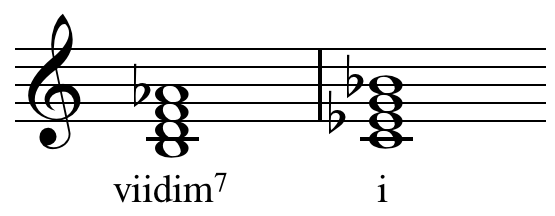
Cadences are divided into four main types: authentic, half, plagal, and deceptive. Authentic cadences move from a dominant-functioning chord (commonly V) to the tonic (I), and are classified as perfect or imperfect. The perfect authentic cadence, with both chords in root position and the tonic in the highest voice, is considered the strongest type. Half cadences end on V, sounding incomplete, and include subtypes such as the Phrygian half cadence (iv6–V in minor). The plagal cadence (IV–I) is a separate main type, not a half cadence.
Reader's Guide
Cadences are fundamental to tonal music, serving as structural markers that define phrases, sections, and entire works. The musicologist Edward Lowinsky proposed that the cadence was the 'cradle of tonality.' While typically classified by chord progressions, a sense of closure is essential for a progression to function as a cadence. Disputes exist, such as William Caplin's argument that plagal cadences (IV–I) rarely occur in classical-era music and instead function as postcadential codettas. The deceptive cadence (V to a chord other than I, often vi) creates a suspended effect. Cadences remain a core concept in analyzing harmony and form from the 16th century onward.
Did You Know?
- The word 'cadence' comes from Latin cadentia 'a falling'.
- A cadence can be labeled 'weak' or 'strong' depending on the impression of finality it gives.
- The Phrygian half cadence (iv6–V in minor) is named for its semitonal bass motion resembling 15th-century Phrygian mode cadences.
- William Caplin disputes the existence of plagal cadences in classical-era music, arguing they are postcadential codettas.
The Musical Mechanism
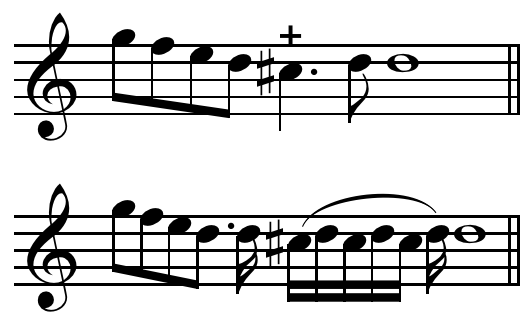
In a standard Medieval cadence, a major sixth interval is resolved by having each note of the interval move outward by one step, expanding the distance to a full octave. The Landini cadence takes this familiar gesture and inserts a moment of unexpected contraction before the final expansion. In the upper voice, an escape tone briefly narrows the interval down to a perfect fifth, creating a fleeting sense of closure that is then immediately undone as the voice continues on to the octave. This brief dip into the fifth before the final stretch to the octave gives the cadence its distinctive, slightly restless character. An inner voice may also participate in the figure; in the standard example, that inner voice moves from F-sharp to G in the same rhythmic pattern as the lower voice, adding harmonic richness to the resolution. The result is a cadential formula that feels both resolved and gently unsettled, a hallmark of late Medieval compositional taste.
Landini's Signature
Francesco Landini (1325–1397) was an influential Italian composer whose name became permanently attached to one of the most recognizable cadential formulas of the late Medieval period. While the technique of narrowing a sixth to a fifth before expanding to an octave existed before his time, Landini distinguished himself by employing it with remarkable consistency across his body of work. This sustained, deliberate use set him apart from his contemporaries and gave the cadence its eponymous identity. The device became so strongly associated with his compositional voice that later scholars would use his name as the primary reference point for the technique. His extensive application of the figure throughout his output made it a kind of musical fingerprint, a signature gesture that listeners and analysts could recognize as distinctly his. In honoring Landini with the cadence's name, the musicological tradition acknowledges not merely that he used the device, but that he elevated it to a defining element of his artistic identity.
A Broader Tradition
The Landini cadence did not emerge in a vacuum, nor did it vanish with its namesake. The technique was a widespread feature of 14th-century and early 15th-century composition, employed by composers well before Landini and long after his death. Gherardello da Firenze appears to be the earliest composer whose surviving works demonstrate the figure, suggesting the practice predates Landini's own output. On the other end of the timeline, the cadence remained a living compositional tool well into the 15th century. It appears with particular frequency in the songs of Gilles Binchois and in the music of Johannes Wreede, both of whom carried the device forward into a new generation of composers. What distinguishes Landini from these predecessors and successors is not invention but consistency: he was the first to deploy the cadence as a recurring, defining element of his style. The broader tradition thus frames Landini not as a solitary innovator but as the composer who gave the technique its most recognizable and enduring association.
Naming and Scholarly Recognition
Despite its long history in actual musical practice, the term 'Landini cadence' is a relatively modern scholarly coinage. The name was first introduced in the late 19th century by the German writer A.G. Ritter, who used it in his 1884 work Zur Geschichte des Orgelspiels, published in Leipzig. This act of naming crystallized what had previously been an unnamed but widely recognized compositional habit into a formal, discussable concept in music theory. The alternative names for the device—'Landini sixth,' 'under-third cadence,' and 'Landini sixth cadence'—all trace back to this same moment of scholarly codification. The fact that the term emerged in the context of a treatise on organ playing suggests that the cadence had become a reference point in broader discussions of musical technique by the 1880s. Ritter's naming ensured that subsequent generations of composers, analysts, and students would have a precise label for the figure, anchoring it firmly in the academic vocabulary of Western music.
Gallery



Frequently Asked Questions
What is a cadence in music theory?
A cadence is a harmonic or rhythmic pattern at the end of a musical phrase that gives the listener a feeling of arrival or completion. Think of it as the musical equivalent of a period at the end of a sentence. The term comes from the Latin word for 'a falling,' reflecting the sense of resolution it creates.
What are the main types of cadences?
The primary subtypes include perfect authentic, imperfect authentic, deceptive, Phrygian half, and minor plagal cadences. Each one creates a different degree of finality or surprise depending on which chords resolve to which. The perfect authentic delivers the strongest sense of closure, while the deceptive deliberately avoids the expected resolution.
How does a cadence tell you what key a passage is in?
Cadences act as strong signals of the tonic because they anchor the listener's ear to the central pitch of a passage or piece. When a phrase resolves convincingly to a particular chord, that chord's root typically reveals the key center. This is why composers use cadences strategically to confirm or shift the tonal center.
What's the difference between a perfect authentic and a deceptive cadence?
A perfect authentic cadence moves from the dominant chord to the tonic in root position, delivering the strongest possible sense of finality. A deceptive cadence sets up that same dominant-to-tonic expectation but resolves to a different chord, usually the submediant, creating a moment of surprise. Both use the dominant as a springboard, but they land in completely different emotional places.
Can a cadence be rhythmic rather than harmonic?
Yes, a rhythmic cadence is a distinctive pattern of note lengths and rests that signals the end of a phrase even without a specific chord progression. It works alongside harmonic cadences to reinforce the feeling of closure. In practice, most phrase endings combine both rhythmic and harmonic elements to create a convincing sense of arrival.
More in Music Theory And Composition 1-24
Elsewhere in the Music Theory And Composition universe
Spotted an error? Know more?
This is a living reference — every entry is fact-audited, and reader corrections feed straight into our audit queue. Suggest an edit · See this site's audit record