
Chord progression
Succession of chords forming the harmonic foundation of Western music.

A chord progression, also known as a harmonic progression or informally as chord changes, is a succession of chords. Chord progressions are the foundation of harmony in Western musical tradition from the common practice era of classical music to the 21st century, and they are the defining feature on which melody and rhythm are built in popular music styles, traditional music, blues, and jazz.
- field
- Music theory
- known_for
- Foundation of harmony in Western music; defining feature of popular music, blues, and jazz
- notation
- Roman numerals (e.g., I–V–vi–IV) or chord names (e.g., E♭ major–B♭ major–C minor–A♭ major)
Lore & Background
In tonal music, chord progressions establish or contradict a tonality, commonly understood as the key of a song. They are usually expressed by Roman numerals in classical music theory, while popular and traditional music often uses chord names and qualities. For example, the common progression I–V–vi–IV in the key of E♭ major is written as E♭ major–B♭ major–C minor–A♭ major. In rock and blues, Roman numerals facilitate transposition; the 12-bar blues is often thought of as I, IV, and V chords, allowing a bandleader to instruct a rhythm section in any key.
Reader's Guide
Chord progressions vary in complexity across genres and historical periods. Simple progressions, such as alternation between two chords (e.g., I and V) or three-chord progressions (I–IV–V), are common in folk, rock, and pop music. The 12-bar blues progression, based on I, IV, and V, has generated countless hit records. More complex progressions appear in bebop jazz, which may have 32-bar forms with one or two chord changes per bar. Diatonic scales provide three major triads (I, IV, V) and three minor triads (ii, iii, vi), plus a diminished chord (viio). Chromatic alterations, such as the raised fourth degree, can create secondary dominants or modulate to new keys. Chord progressions are often limited to a few bars and certain favored sequences help define entire genres, such as the 12-bar blues.
Did You Know?
- Chord progressions are the foundation of harmony in Western musical tradition from the common practice era to the 21st century.
- The 12-bar blues progression is often expressed as I–I–I–I, IV–IV–I–I, V–IV–I–I in Roman numerals.
- Some funk songs may be based on a single chord, while bebop jazz songs may have one or two chord changes every bar.
- The diatonic harmonization of any major scale results in three major triads (I, IV, V) and three minor triads (ii, iii, vi).
The Architectural Backbone of Western Music
In the vast landscape of Western music, chord progressions occupy a role far more fundamental than mere accompaniment. From the common practice era of classical composition all the way through to the twenty-first century, a succession of chords has served as the structural bedrock upon which harmony is constructed. This is not limited to concert halls. In popular music—pop, rock, blues, jazz, and traditional folk styles—chord progressions are not just a supporting element; they serve as the defining structural element upon which both melody and rhythm are constructed. Within tonal music specifically, a progression carries a functional purpose: it either establishes a tonality, the formal name for what most people simply call the key of a piece, or it deliberately contradicts that tonality to create tension and forward motion. This dual capacity means that even a short sequence of chords can act as a narrative device, telling the ear where it is, where it might be heading, and where it ultimately returns. The progression is, in essence, the grammar of harmonic language, and without it the other elements of music lose their referent.
Two Languages for the Same Idea
Musicians have developed at least two distinct notational systems for describing chord progressions, each suited to different musical cultures. In classical theory, the standard approach uses Roman numerals—capital for major triads, lowercase for minor, a small circle for diminished—so that a progression like I–V–vi–IV communicates its harmonic logic independent of any specific key. This abstraction is particularly valued in rock and blues, where a bandleader can hand a rhythm section a chart written entirely in numerals and simply announce a new key. The twelve-bar blues, for instance, is commonly reduced to I–I–I–I, IV–IV–I–I, V–IV–I–I, and the same pattern can be realized in B♭ major as B♭–B♭–B♭–B♭, E♭–E♭–B♭–B♭, F–E♭–B♭–B♭ without any other change. In pop, jazz, and traditional settings, the alternative is to write out actual chord names and qualities on a lead sheet or fake book. That same I–V–vi–IV in E♭ major becomes E♭ major–B♭ major–C minor–A♭ major, where the root note and the word 'major' or 'minor' spell out exactly what the player must build. Both systems describe identical harmonic motion; they simply speak to different ears.
Building Blocks: Diatonic and Chromatic Harmony
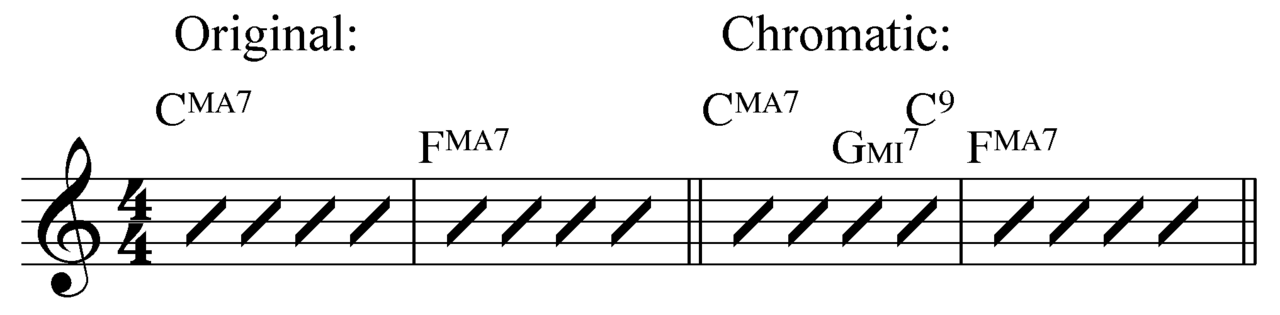
A seven-note diatonic scale yields seven basic triads, one for each degree, and these form the raw material from which most Western progressions are assembled. In any major key, three of those triads are major: the tonic (I), the subdominant (IV), and the dominant (V). Together they encompass every note of the scale, which is why so many folk, rock-and-roll, and traditional songs—The Troggs' "Wild Thing" being a textbook case—rely on nothing more than these three. The remaining scale degrees produce three minor triads (ii, iii, vi) and one diminished triad (vii°) on the leading tone. Beyond the diatonic palette, composers and improvisers introduce chromatic notes—pitches outside the home scale—to create color and motion. A classic example is raising the third of the ii chord by a semitone, producing a secondary dominant (V/V) that pulls strongly toward the dominant. Chromatic chords can also serve as a bridge into a new key, a modulation, after which the progression may eventually resolve back to the original tonality, giving the listener a sense of departure and return. Even within a single diatonic progression, a chord's function is never fixed; it depends entirely on the surrounding context.
A Spectrum of Simplicity and Complexity
The number of chords in a progression is one of the most visible differences between musical genres and eras. Some pop and rock songs from the 1980s through the 2010s employ fairly simple progressions, while punk and hardcore punk tracks may cycle through only a handful of chords. Funk takes minimalism to an extreme: because the groove and rhythmic feel are the central elements, an entire funk song can be built on a single sustained chord, and jazz-funk pieces often loop a two-, three-, or four-chord vamp. In the other direction, bebop jazz compositions frequently feature thirty-two-bar song forms in which the harmony shifts one or two times per bar, demanding rapid navigational skill from every player. This range is not unique to Western traditions. Arab and Indian music, while using diatonic scales, typically contains no chord changes at all, remaining fixed on the key-chord throughout—a practice also observed in hard rock, hip-hop, disco, and certain jazz contexts. At the simplest end of the spectrum, alternation between just two chords constitutes a complete progression, and many well-known pieces are built on exactly that principle.
Gallery


Frequently Asked Questions
What exactly is a chord progression?
A chord progression is a sequence of chords played in succession, forming the harmonic skeleton of a musical piece. It is the structural framework that supports melody and rhythm across virtually every Western music style, from classical to modern pop.
How do musicians notate a chord progression?
Progressions are typically written either in Roman numerals (e.g., I–V–vi–IV) to show each chord's functional role within a key, or with concrete chord names (e.g., E♭ major–B♭ major–C minor–A♭ major) to specify exact pitches.
Why is the chord progression considered the defining feature of popular music?
In pop, blues, and jazz, the progression acts as the primary organizing element that listeners subconsciously recognize, while melody and rhythm are layered on top of it. This is in contrast to much classical writing, where the melodic line often takes the lead and harmony supports it.
What role do chord progressions play in the common practice era of classical music?
During the common practice period, composers used progressions to create tension, release, and large-scale tonal architecture across movements. They remain the foundational harmonic language from which later genres inherited their sense of direction and resolution.
Can a piece of music exist without a chord progression?
Yes—monophonic folk songs, drum-and-bass tracks, or free-improvisation pieces may lack a defined harmonic sequence. However, in the vast majority of Western tonal music, some form of chord succession underpins the structure, even if it is implied rather than explicitly written.
More in Music Theory And Composition 1-24
Elsewhere in the Music Theory And Composition universe
Spotted an error? Know more?
This is a living reference — every entry is fact-audited, and reader corrections feed straight into our audit queue. Suggest an edit · See this site's audit record