
Register (music)
Register defines pitch range and timbre in music.

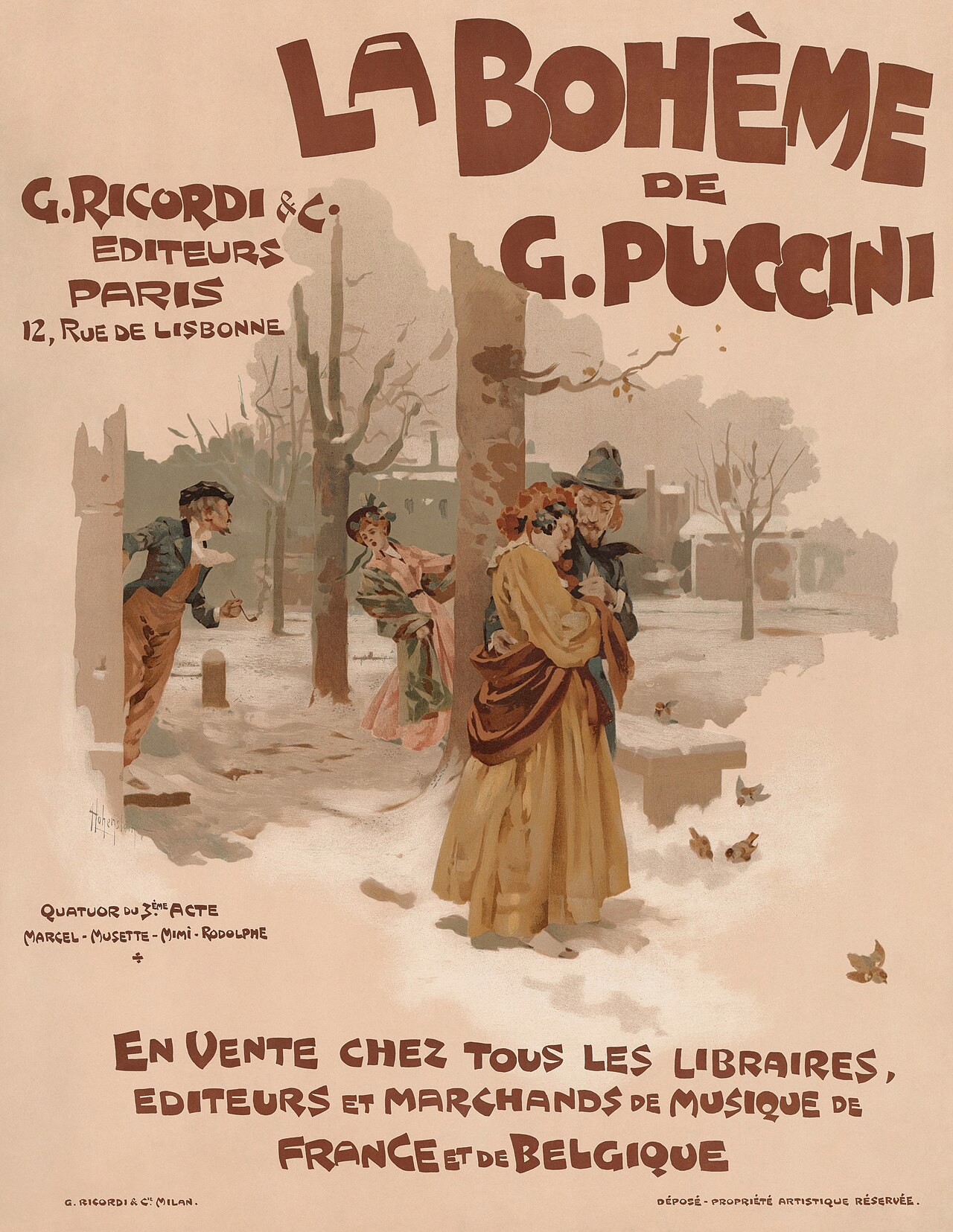
Adolf Hohenstein (1854-1928) for G. Ricordi & C., Milan, restored by Adam Cu · Public domain
Register in music refers to the range within pitch space of some music or often musical speech. It may describe a given pitch or pitch class, a human voice or musical instrument, or both, as in a melody or part. Register is often related to timbre and musical form, and in musical compositions it may be fixed or 'frozen'.
- field
- Music theory and performance
- known_for
- Describing pitch ranges, timbre, and structural use in musical form
Lore & Background
Register is understood in relation to other musical parameters. A higher register indicates a higher pitch, as when violins are said to be in a higher register than cellos. The register in which an instrument plays affects its timbre, and register is used structurally in musical form, with the climax of a piece usually in the highest register. Some modernist and twelve-tone pieces have fixed or frozen register, allowing a pitch class to be expressed through only one pitch, a technique associated with Anton Webern and later used by Arthur Berger, Pierre Boulez, Elliott Carter, and Karlheinz Stockhausen. Registral expansion—the widening of range across higher and lower pitches—creates a sense of growth or dramatic unfolding.
Reader's Guide
Register is a fundamental concept in music, linking pitch, timbre, and form. In human voice, it refers to a series of tones of like quality originating from laryngeal operation, with speech pathologists recognizing four vocal registers: vocal fry, modal, falsetto, and whistle. In wind instruments, register distinguishes pitch ranges produced by different normal modes of the air column, with higher registers produced by overblowing. The Western concert flute has three complete registers and one partial register, while the clarinet has a separate 'throat register' with distinctive timbre and fingerings. Register's role in musical form and its use in fixed-register serialism highlight its structural importance. The concept remains essential for understanding instrumental technique, vocal pedagogy, and compositional design, providing a framework for analyzing how pitch and timbre interact across musical contexts.
Did You Know?
- Register may be fixed or 'frozen' in some modernist and twelve-tone pieces, allowing a pitch class to be expressed through only one pitch.
- The Western concert flute has three complete registers and one partial register, with the second register beginning at E5.
- Speech pathologists recognize four vocal registers: vocal fry, modal, falsetto, and whistle.
- Registral expansion is the widening of a melodic, harmonic, or textural range, creating a sense of growth or dramatic unfolding.
Register as a Musical Parameter
Register occupies a central place in how musicians think about pitch space. At its most basic level, it names the range within which a melody, a vocal part, or an instrumental line operates. The concept is broad enough to describe a single pitch class, an entire voice or instrument, or a combination of both within a composition. Crucially, register does not exist in isolation; it is understood in relation to other musical parameters. A higher register generally signals a higher pitch — violins, for instance, are routinely described as sitting in a higher register than cellos, a distinction often shorthand-notated with subscripted numerals in scientific pitch notation. Beyond pitch, the register in which a part is written shapes the quality of sound, or timbre, that the listener hears. Register also serves a structural role in musical form: the climax of a piece is typically placed in its highest register, giving the architecture of the work a directional pull toward the top of the pitch space. In some compositions, particularly those from the modernist tradition, register may be deliberately fixed or frozen, locking each pitch class into a single specific pitch.
Frozen Register and the Serial Tradition
One of the most striking applications of the register concept appears in twentieth-century modernist composition, where the idea of a fixed or frozen register became a defining compositional technique. In this approach, each pitch class is permitted to sound at only one specific pitch, eliminating the freedom to transpose that class to different octaves throughout a piece. The technique is most closely associated with Anton Webern, whose works established the precedent. After Webern, the frozen-register principle found its way into the music of several major figures of the serial and post-serial traditions: Arthur Berger, Pierre Boulez, Elliott Carter, and Karlheinz Stockhausen all employed or adapted the idea in their own compositions. By restricting a pitch class to a single register, composers gained a new structural clarity — the listener could track individual pitch classes without the ambiguity of octave displacement. This constraint also interacted with the broader registral expansion that characterizes dramatic musical unfolding, creating a tension between the fixed registral identity of each note and the widening of the overall melodic, harmonic, or textural range across a work.
The Human Voice and Its Registral Architecture
When applied to the human voice, the term register takes on a particularly rich and multi-layered meaning. A vocal register — the whistle register, for example — is a series of tones sharing a common quality, produced through the operation of the larynx. The underlying mechanism involves the vocal folds vibrating in similar patterns; each distinct pattern yields a characteristic sound within a particular pitch range. The word's application is broad: it can designate a specific segment of the vocal range, a resonance area such as chest voice or head voice, a particular phonatory process, a recognizable vocal timbre, or a region of the voice demarcated by vocal breaks. Speech pathologists and many vocal pedagogues identify four principal vocal registers — vocal fry, modal, falsetto, and whistle — and they delineate these by specifying the vibratory pattern of the vocal folds, the sequential pitches involved, and the type of sound produced. This framework gives singers, teachers, and clinicians a shared vocabulary for describing how the voice shifts its production mechanism as it moves through its full range.
Wind Instruments and the Physics of Registers
For wind instruments, the concept of register is rooted in the physics of the air column. The term typically distinguishes pitch ranges produced by different normal modes of vibration, with higher registers achieved through overblowing — forcing the column into a higher harmonic. This distinction is especially audible on woodwinds, where the timbres of different registers tend to be markedly different, giving each section of the instrument's range a unique color. The Western concert flute, spanning roughly three and a half octaves, generally offers three complete registers plus one partial register. Middle C (C4) falls in the first register, while the second register — the one requiring overblowing — begins at E5. The clarinet presents an even more nuanced picture: the notes from written G4 or A4 up to B♭4 are sometimes treated as a separate throat register. Although these notes are produced using the same lowest normal mode as the notes below F♯4, their timbre is distinctly different, and their fingerings are distinctive as well, relying on special keys rather than the standard tone holes used for the rest of the instrument's range.
Gallery





Frequently Asked Questions
What does 'register' mean in music theory?
Register refers to the specific area of pitch space that a melody, instrument, or voice occupies within a piece. It can describe a single pitch or pitch class, the full range of a voice or instrument, or the span of a particular melodic line.
How is register connected to timbre?
The register in which a sound is produced strongly shapes its timbre, since the same instrument or voice sounds markedly different in its low versus high range. Composers exploit this relationship to add color and contrast to their writing.
Can a composer lock a register in place within a composition?
Yes—register can be fixed or 'frozen' in a score, meaning a particular voice or instrument stays within a defined pitch band for an extended passage. This structural choice helps delineate sections and maintain textural contrast.
What exactly does register describe in terms of pitch?
It can pinpoint a single pitch or pitch class, outline the full range of a human voice or instrument, or characterize the span of a specific melodic part. In practice, all three uses appear in both performance and analysis.
Why does register matter for musical form?
Because shifts in register create audible boundaries between sections, they serve as a structural tool alongside harmony and rhythm. A composer's choice of where to place melodic material in pitch space directly shapes how a piece feels organized.
More in Music Theory And Composition 25-27
Elsewhere in the Music Theory And Composition universe
Spotted an error? Know more?
This is a living reference — every entry is fact-audited, and reader corrections feed straight into our audit queue. Suggest an edit · See this site's audit record