
Pitch (music)
Pitch is the subjective perception of sound frequency.
Pitch is the quality that lets us hear sounds as "higher" or "lower," especially in the context of musical melodies. It is a perceptual attribute, meaning it allows sounds to be arranged on a scale related to frequency. Along with duration, loudness, and timbre, pitch is a key auditory feature of musical tones. While pitch can be expressed as a frequency, it is not a purely objective physical measurement; instead, it is a subjective psychoacoustical experience. The study of pitch and how we perceive it has long been a core issue in psychoacoustics, helping to shape and test theories about how the auditory system represents, processes, and perceives sound.
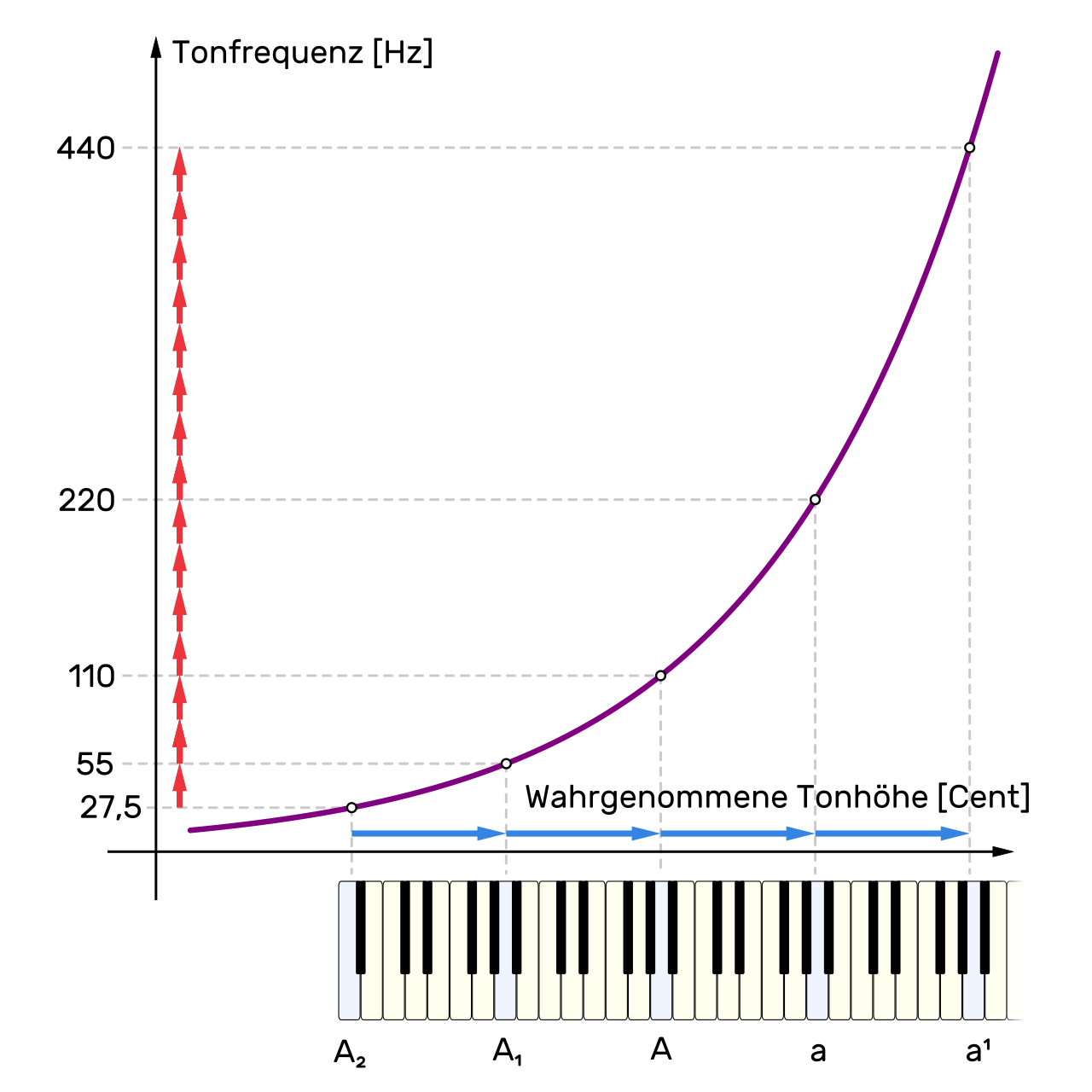
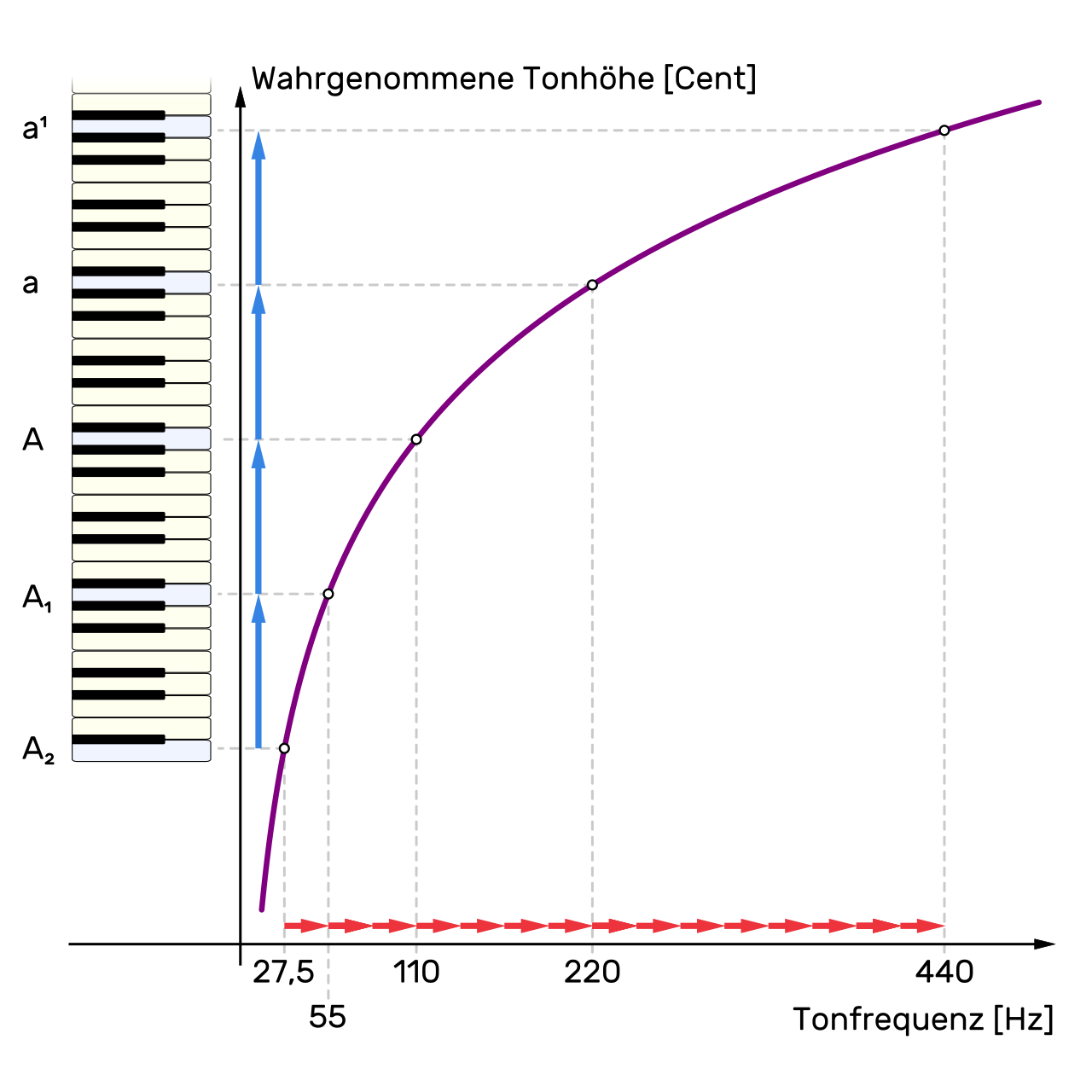
Pitch is an auditory sensation where a listener places musical tones on a relative scale, based mainly on their perception of vibration frequency. Frequency is an objective, measurable physical property, but pitch is the subjective individual experience of a sound wave and cannot be directly measured. Still, people generally agree on which notes are higher or lower. Sound wave oscillations are often described by frequency, and pitches are usually quantified as frequencies (in hertz) by comparing sounds to pure tones with sinusoidal waveforms. Even complex or aperiodic sound waves can often be assigned a pitch this way.
The American National Standards Institute defines pitch as the auditory attribute that lets sounds be ordered from low to high. Because pitch closely mirrors frequency, it is almost entirely determined by how fast the air vibrates, with almost no connection to the wave's intensity or amplitude. Rapid oscillation produces a "high" pitch, and slower oscillation a "low" one. The metaphor linking vertical height to pitch is common across most languages; in English, it is one of many deep conceptual metaphors involving up and down, though the exact etymological origin of "high" and "low" pitch in music remains unclear. Evidence suggests that people actually perceive a sound source as slightly higher or lower in vertical space when its frequency is increased or decreased.
For most complex sounds like speech and musical notes, pitch corresponds very closely to the repetition rate of periodic or nearly-periodic sounds, or to the reciprocal of the time interval between repeating events in the waveform. However, the pitch of complex tones can be ambiguous, meaning different listeners may perceive two or more different pitches. When the actual fundamental frequency can be measured physically, it may differ from the perceived pitch due to overtones (upper partials, harmonic or otherwise). For example, a complex tone made of two sine waves at 1000 and 1200 Hz might be heard as up to three pitches: two spectral pitches at 1000 and 1200 Hz from the pure tones, and a combination tone at 200 Hz, which corresponds to the waveform's repetition rate. This 200 Hz percept is often called the missing fundamental, typically the greatest common divisor of the frequencies present.
Pitch also depends, to a lesser degree, on sound pressure level (loudness), especially at frequencies below 1000 Hz and above 2000 Hz. For lower tones, pitch gets lower as sound pressure increases; for instance, a very loud 200 Hz tone can sound about one semitone lower than when it is barely audible. Above 2000 Hz, pitch gets higher as the sound gets louder. These findings came from pioneering work by S. Stevens and W. Snow. Later investigations, such as those by A. Cohen, showed that in most cases, apparent pitch shifts were not significantly different from pitch-matching errors. When averaged, the remaining shifts followed the direction of Stevens's curves but were small—2% or less by frequency, no more than a semitone.
Theories of pitch perception aim to explain how physical sound and the auditory system's physiology combine to create the experience of pitch. These theories generally fall into two categories: place coding and temporal coding. Place theory suggests that pitch perception is determined by the location of maximum excitation on the basilar membrane. A place code, relying on the auditory system's tonotopic organization, must be used for perceiving high frequencies because neurons have an upper limit on how fast they can phase-lock their action potentials. However, a purely place-based theory cannot account for accurate pitch perception in low and middle frequency ranges. Additionally, some non-human primates show no pitch responses in the auditory cortex despite having clear tonotopic maps, indicating that tonotopic place codes alone are insufficient for pitch.
Temporal theories offer an alternative, focusing on the timing of action potentials, particularly their phase-locking to stimulus frequencies. Exactly how this temporal structure codes for pitch at higher levels is still debated, but the processing appears to rely on an autocorrelation of action potentials in the auditory nerve. However, it has long been noted that a neural mechanism capable of producing the delay required for true autocorrelation has not been found.
- field
- Psychoacoustics, Music
- known_for
- Pitch as a subjective psychoacoustical attribute of sound, closely related to but not equivalent to frequency
- key_concept
- Pitch is quantified as frequency but is a subjective perception, not a purely objective physical property
Lore & Background
Pitch is an auditory sensation in which a listener assigns musical tones to relative positions on a musical scale based primarily on their perception of the frequency of vibration. Frequency is an objective, scientific attribute that can be measured, while pitch is the subjective perception of a sound wave by the individual person, which cannot be directly measured. However, this does not necessarily mean that people will not agree on which notes are higher and lower. According to the American National Standards Institute, pitch is the auditory attribute of sound allowing those sounds to be ordered on a scale from low to high. Since pitch is such a close proxy for frequency, it is almost entirely determined by how quickly the sound wave is making the air vibrate and has almost nothing to do with the intensity, or amplitude, of the wave.
Reader's Guide
Pitch is a foundational concept in music and psychoacoustics, bridging objective physical measurements and subjective human perception. Its study has been central to understanding how the auditory system processes sound, leading to theories such as place coding and temporal coding. Place theory holds that pitch perception is determined by the place of maximum excitation on the basilar membrane, while temporal theories appeal to the phase-locking of action potentials. Pitch perception can be ambiguous, as with complex tones where a missing fundamental may be perceived, and can be fooled by aural illusions such as the Shepard scale. The concept of definite versus indefinite pitch distinguishes instruments that produce clear pitches from those that do not.
Did You Know?
- Pitch is not a purely objective physical property but a subjective psychoacoustical attribute of sound.
Origins and Theoretical Lineage
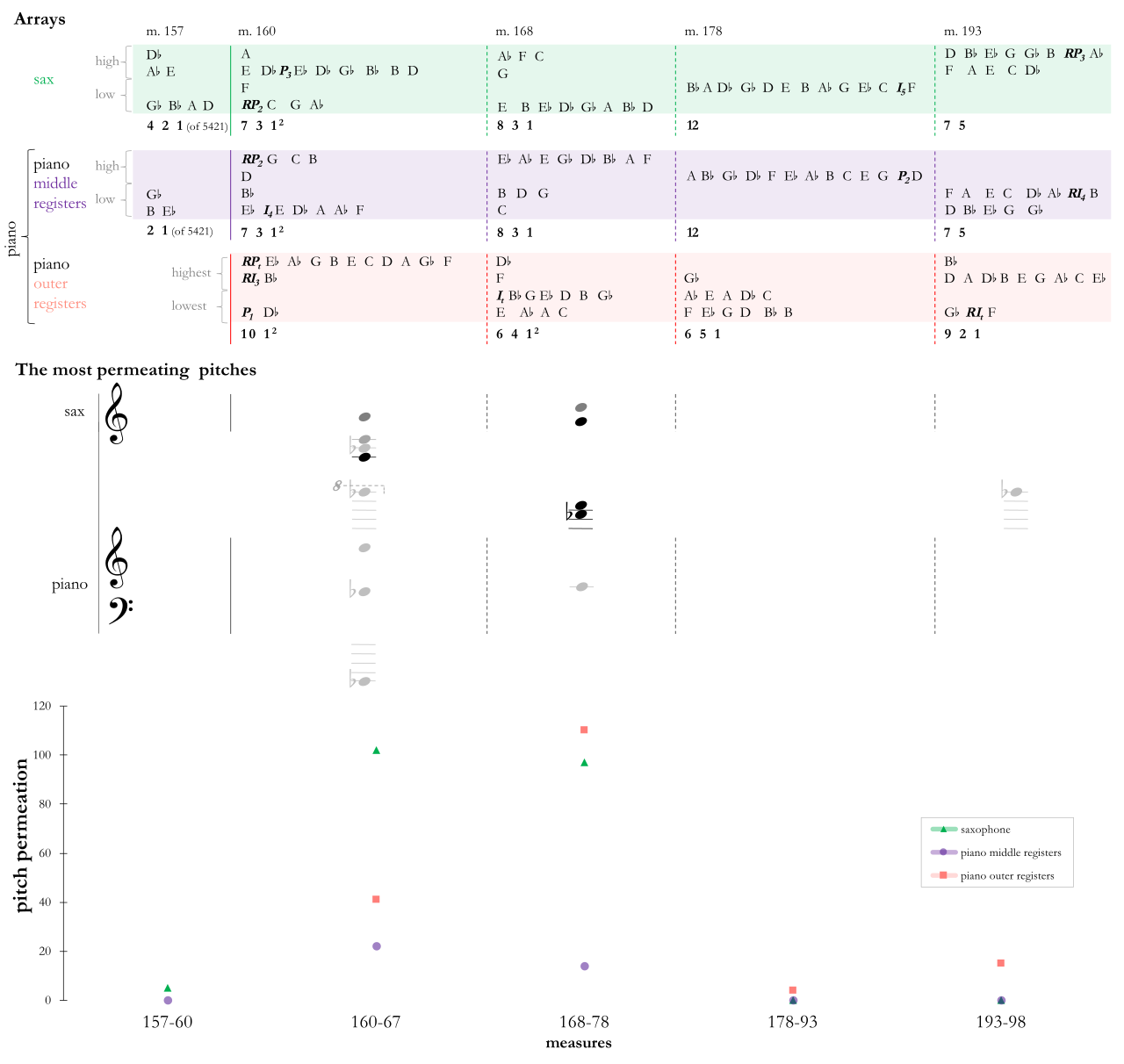
Musical set theory emerged from a progression of scholarly work that expanded the analytical toolkit available to musicologists. Howard Hanson was the pioneer who first elaborated a substantial body of concepts aimed at analyzing tonal music, laying the groundwork for what would become a formalized discipline. Building on that foundation, Allen Forte extended the framework to accommodate atonal works, drawing heavily on the twelve-tone theory associated with Milton Babbitt. This expansion was significant because it meant the same structural vocabulary could address both traditional harmonic language and the more complex pitch organizations of the twentieth century. The resulting concepts are remarkably general in scope: they apply across tonal and atonal styles within any equal-tempered tuning system, and in some respects they reach even beyond that boundary. A few theorists have gone further still, adapting the methods to the analysis of rhythm rather than pitch alone, demonstrating the flexibility of the underlying logic.
The Central Postulate and Core Operations
At the heart of musical set theory lies a principle that functions almost like a foundational axiom: transposition and inversion are isometries of pitch-class space, meaning they preserve the intervallic structure of a set even when the specific notes change. This is widely regarded as the central postulate of the entire field. In practical analysis, this principle drives much of the work, as analysts search for non-obvious transpositional or inversional relationships between sets embedded in a composition. Beyond these two primary operations, some authors incorporate complementation—the set of all pitch classes not contained in a given set—and multiplication of pitch-class numbers modulo twelve. Because these additional operations are not isometries, they do not necessarily preserve musical character. Allen Forte also emphasized the Z-relation, a connection between two sets that share identical interval content yet are neither transpositionally nor inversionally equivalent; Hanson had earlier labeled this same relationship isomeric. For ordered sequences, the toolkit expands to include retrograde, which reverses element order, and rotation, equivalent to cyclic permutation.
A Distinct Relationship to Mathematics
A common misconception holds that musical set theory is simply mathematical set theory applied to music, yet the two disciplines differ in both method and terminology in numerous ways. Where musicians speak of transposition and inversion, a mathematician would more naturally use the terms translation and reflection. When musical set theory refers to ordered sets, the mathematical equivalent would typically be called a tuple or a sequence—concepts that, while they can encompass the musical kind in some sense, are far more involved in their formal definitions. In reality, musical set theory aligns more closely with group theory and combinatorics than with the branch of mathematics that concerns itself with, for instance, various sizes of infinitely large sets. In combinatorics specifically, an unordered subset of n objects is termed a combination, while an ordered subset is a permutation. For this reason, musical set theory is better understood as an application of combinatorics to music theory rather than as a subfield of mathematical set theory. Its principal link to the latter is simply the borrowing of set-theoretic vocabulary to discuss finite collections.
Taxonomy, Notation, and Scope of Sets
The fundamental building block of the theory is the musical set: an unordered collection of pitch classes, formally represented as a set of distinct integers without duplicates. In actual music, the elements of such a set might appear as simultaneous chords, as successive tones in a melody, or as a combination of both. Notational conventions vary among authors, but unordered sets are typically enclosed in curly braces or square brackets, while ordered sequences are marked with angle brackets or separated by spaces. A crucial subtlety is that the assignment of zero to a particular pitch is not fixed; a piece with a clear center on F might be most usefully analyzed with F as zero, shifting the entire numerical mapping. While set theorists most commonly work with equal-tempered pitch classes, the framework can also accommodate non-equal-tempered pitch classes, rhythmic onsets, or beat classes. Sets are classified by cardinality: dyads (two elements), trichords (three), tetrachords, pentachords, hexachords, heptachords, octachords, nonachords, decachords, undecachords, and finally the complete dodecachord.
Gallery



Frequently Asked Questions
Who is Pitch (music)?
Pitch is the perceptual quality that lets listeners rank sounds from higher to lower, forming the backbone of melody. It sits alongside duration, loudness, and timbre as one of the core attributes of any musical tone.
What are Pitch (music)'s powers/role?
Pitch gives music its sense of direction and contour, allowing tones to be arranged into scales, chords, and melodic lines. Without it, sound would remain undifferentiated noise rather than organized music.
How does Pitch (music) differ from frequency?
Although pitch is quantified using frequency measurements in hertz, it is ultimately a subjective perceptual judgment rather than a purely physical property. Two tones at the same frequency can still feel different in pitch depending on context and the listener's auditory system.
Why is Pitch (music) important?
Pitch perception is a central puzzle in psychoacoustics because it reveals how the brain transforms physical vibrations into meaningful musical experience. Understanding it has driven major advances in theories of how the auditory system represents and processes sound.
What field does Pitch (music) belong to?
Pitch sits at the intersection of music theory and psychoacoustics, bridging the physical science of sound waves with the subjective experience of hearing. It is studied both as a compositional tool and as a window into neural auditory processing.
More in Music Theory And Composition 1-24
Spotted an error? Know more?
This is a living reference — every entry is fact-audited, and reader corrections feed straight into our audit queue. Suggest an edit · See this site's audit record